
We will stay firmly rooted in Chinese culture. We will collect and refine the defining symbols and best elements of Chinese culture and showcase them to the world. We will accelerate the development of China’s discourse and narrative systems, better tell China’s stories, make China’s voice heard, and present a China that is credible, appealing, and respectable.
習近平會見歐洲理事會主席科斯塔、歐盟委員會主席馮德萊恩
發佈時間:2025-07-25 10:27:28 | 來源:新華網 | 作者: | 責任編輯:曹川川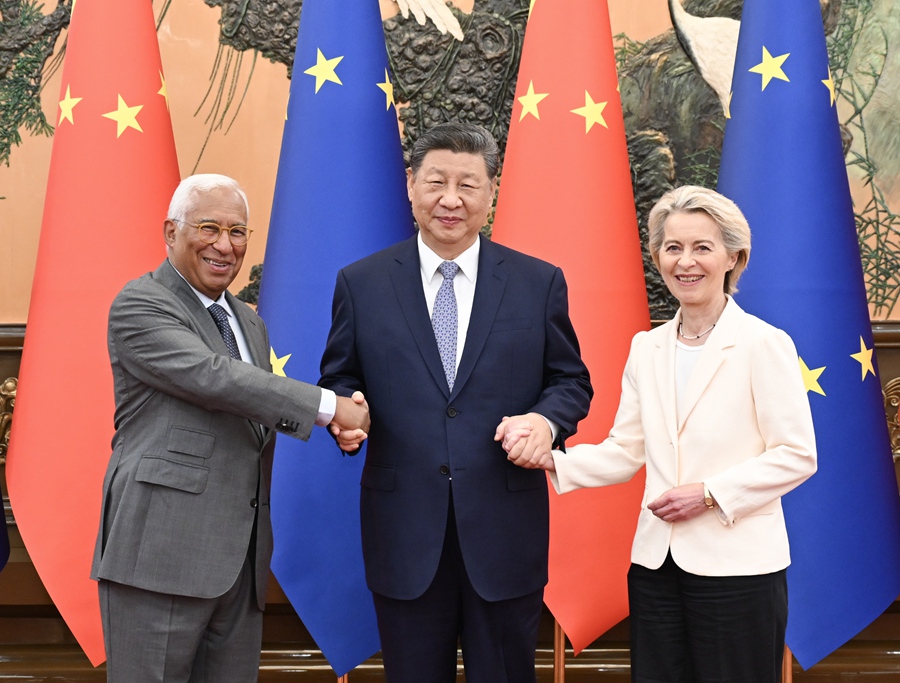
7月24日上午,國家主席習近平在北京人民大會堂會見來華舉行第二十五次中國-歐盟領導人會晤的歐洲理事會主席科斯塔和歐盟委員會主席馮德萊恩。新華社記者 謝環馳 攝
7月24日上午,國家主席習近平在北京人民大會堂會見來華舉行第二十五次中國-歐盟領導人會晤的歐洲理事會主席科斯塔和歐盟委員會主席馮德萊恩。
習近平指出,中歐建交50年來,交流合作成果豐碩,既成就彼此又惠及世界,其中的重要經驗和啟示就是相互尊重、求同存異、開放合作、互利共贏。這也是中歐關係未來發展應該堅持的重要原則和努力方向。今年是中歐建交50週年和聯合國成立80週年,中歐關係又站在一個關鍵歷史節點。中歐都是主張多邊主義、倡導開放合作的建設性力量,國際形勢越是嚴峻複雜,中歐就越要加強溝通、增進互信、深化合作。面對加速演進的世界百年變局和變亂交織的國際形勢,中歐領導人應再次展現遠見和擔當,作出符合人民期待、經得起歷史檢驗的戰略抉擇,牢牢把握中歐關係發展的正確方向,努力開闢中歐關係更加光明的下一個50年,為世界提供更多穩定性和確定性。
習近平就中歐關係未來發展提出三點主張。一是堅持相互尊重,鞏固夥伴關係定位。中國是熱愛和平的國家,主張和諧、包容、合作、共贏。如果用西方走過的路來衡量中國,對中國的認知就會失之偏頗。中歐歷史文化、道路制度、發展階段的確不同,但這種差異過去沒有成為中歐建交和關係發展的障礙,今後也不應該阻礙雙方關係發展。當前歐洲面臨的挑戰不是來自中國。中歐之間沒有根本利害衝突和地緣政治矛盾,合作大於競爭、共識多於分歧的基本面和主基調沒有變。中方始終從戰略高度和長遠角度看待和發展中歐關係,將歐洲視為多極世界中的重要一極,一貫支援歐洲一體化和歐盟戰略自主。希望歐方也能尊重中國人民選擇的道路和制度,尊重中國的核心利益和重大關切,支援中國發展繁榮。中歐關係不針對、不依附、也不受制于第三方。雙方要深化戰略溝通,增進理解和互信,樹立正確的相互認知。
二是堅持開放合作,妥善處理分歧摩擦。歷史和現實證明,相互依賴不是風險,利益交融不是威脅,提升競爭力不能靠“築墻設壘”,“脫鉤斷鏈”只會孤立自己。“降依賴”不能減合作。中歐經貿關係的本質是優勢互補、互利共贏,應該也完全能夠在發展中實現動態平衡。中國高品質發展、高水準對外開放將為中歐合作提供新機遇、拓展新空間。中歐要深化綠色和數字夥伴關係,促進相互投資合作。希望歐方保持貿易和投資市場開放,克制使用限制性經貿工具,為中國企業赴歐投資興業提供良好營商環境。
三是踐行多邊主義,維護國際規則秩序。面對戰爭與和平、競爭與合作、封閉與開放的重大選擇,多邊主義、團結合作才是正確答案。中歐要共同維護第二次世界大戰結束後建立起來的國際規則和國際秩序,與時俱進推動構建更加公正合理的全球治理體系,攜手應對氣候變化等全球性挑戰,讓多邊主義的火炬照亮人類前行之路。中歐要支援通過政治手段和平解決國際爭端。中方一貫從事情本身的是非曲直出發,主張勸和促談,倡導標本兼治。中方願同歐方加強協調,推動今年聯合國氣候變化貝倫大會取得成功,為應對氣候變化和全球綠色轉型作出更大貢獻。中方也願同歐方開展人工智慧領域政策溝通和務實合作,共同推動平等有序的世界多極化、普惠包容的經濟全球化。

7月24日上午,國家主席習近平在北京人民大會堂會見來華舉行第二十五次中國-歐盟領導人會晤的歐洲理事會主席科斯塔和歐盟委員會主席馮德萊恩。新華社記者 李響 攝
歐方表示,習近平主席有關歐中關係的三點主張至關重要。建交50年來,歐中在廣泛領域開展合作,規模和深度不斷拓展,成為彼此重要合作和貿易夥伴,助力了各自經濟繁榮和人民福祉提升。中國已成為製造業和科技大國,讓數億人脫貧,中國的發展令全球震撼,給世界重要啟示,歐方相信並支援中國取得更大發展。歐盟和中國都是世界上的重要力量,歐中關係對雙方和世界都極為重要。歐方致力於深化歐中關係,建設性處理分歧,推動雙方合作在平衡、對等、互惠基礎上持續取得更多積極成果。歐方不尋求與中國“脫鉤斷鏈”,歡迎中國企業到歐洲投資興業。面對動蕩不安、充滿不確定性的世界,歐中要擔負責任,共同堅持多邊主義,維護聯合國憲章宗旨和原則,攜手應對氣候變化等全球性挑戰,推動解決地區熱點問題,維護世界和平穩定。歐方期待同中方一道,續寫歐中關係下一個50年更加精彩的篇章。
王毅參加會見。
Xi calls on China, EU to provide more stability, certainty for world through steady, sound bilateral relations

Chinese President Xi Jinping meets with President of the European Council Antonio Costa and President of the European Commission Ursula von der Leyen, who are in China for the 25th China-EU Summit, at the Great Hall of the People in Beijing, capital of China, July 24, 2025. (Xinhua/Xie Huanchi)
Chinese President Xi Jinping on Thursday called on China and the European Union (EU) to provide more stability and certainty for the world through steady and sound China-EU relations.
Xi made the remarks when meeting with President of the European Council Antonio Costa and President of the European Commission Ursula von der Leyen, who are here for the 25th China-EU Summit in Beijing.
Noting that this year marks the 50th anniversary of China-EU diplomatic ties, and the 80th anniversary of the United Nations, Xi said China-EU relations have come to another critical juncture in history.
He said over the past 50 years, China and the EU have achieved fruitful outcomes in exchanges and cooperation, delivering mutual success and worldwide benefits. An important understanding and insight is that the two sides should respect each other, seek commonality while reserving differences, uphold openness and cooperation, and pursue mutual benefit.
These are also important principles and the right direction for China-EU relations in the future, Xi said. Faced with accelerating global transformation not seen in a century and a changing and turbulent world, Chinese and EU leaders should once again demonstrate vision and leadership, and make the right strategic choices that will meet people's expectations and stand the scrutiny of history, he added.
Xi underscored the importance for China and the EU, both constructive forces for multilateralism and openness and cooperation, to strengthen communication, enhance trust and deepen cooperation in a more challenging and complex international situation, in order to provide more stability and certainty for the world through steady and sound China-EU relations.
Xi put forward three propositions for the future development of China-EU relations.
Firstly, both sides should uphold mutual respect and consolidate the positioning of China-EU relations as partnership.
China is a peace-loving country committed to harmony, inclusiveness, cooperation and win-win results, Xi said. While China and the EU differ in history and culture, development paths and systems, and stages of development, such differences have never impeded the establishment of diplomatic relations or the growth of bilateral ties in the past, nor should they obstruct the development of bilateral relations in the future.
The current challenges facing the EU do not come from China, and there are no fundamental conflicts of interest or geopolitical contradictions between China and the EU, Xi said. The fundamentals and prevailing trend of China-EU relations featuring cooperation over competition and consensus over differences have remained constant.
China has always viewed and developed China-EU relations from a strategic and long-term perspective, regarded the EU as an important pole in a multipolar world, and consistently supported European integration and the strategic autonomy of the EU, he said.
Xi voiced hope that the EU will respect the path and system chosen by the Chinese people, respect China's core interests and major concerns, and support its development and prosperity.
China-EU relations are not targeted at, subjugated to, or controlled by any third party, Xi said. He called on both sides to deepen strategic communication, enhance understanding and mutual trust, and foster a correct perception of each other.
Secondly, the two sides should uphold openness and cooperation, and properly manage differences and frictions, Xi said.
History and reality show that interdependency is not a risk, and convergent interests are not a threat, Xi noted, pointing out that boosting competitiveness should not rely on building walls or barriers, as decoupling and severing supply chains will only result in self-isolation.
Xi said that "reducing dependency" should not lead to reducing China-EU cooperation. The bilateral economic and trade relationship, which is by nature complementary and mutually beneficial, can indeed achieve dynamic equilibrium through development, he said.
China's high-quality development and opening-up will provide new opportunities and potentials for China-EU cooperation, Xi noted, calling on both sides to strengthen green and digital partnership, and boost mutual investment and cooperation.
It is hoped that the EU can remain open in trade and investment market, refrain from using restrictive economic and trade tools, and foster a sound business environment for Chinese enterprises investing and operating in the EU, Xi stressed.
Thirdly, Xi called on the two sides to practice multilateralism and uphold the international rules and order.
Confronted with the critical choice between war and peace, competition and cooperation, or seclusion and openness, multilateralism and solidarity-based cooperation remain the only viable approach, he said.
Xi said China and the EU should jointly uphold the international rules and order established after World War II, advance a more just and equitable global governance system in keeping with the times, and work together to address global challenges such as climate change.
Xi said China stands ready to strengthen coordination with the EU to ensure the success of this year's UN Climate Change Conference in Belem (COP30), and contribute more to global climate response and green transition. China is also willing to have policy exchanges and practical cooperation with the EU in artificial intelligence, and jointly advance an equal and orderly multipolar world and a universally beneficial and inclusive economic globalization.
The EU side said that Xi's three propositions on EU-China relations are of vital importance. Since the establishment of diplomatic relations 50 years ago, the EU and China have carried out cooperation in a wide range of fields, becoming each other's major cooperative and trading partners. This has contributed to the economic prosperity of both parties and the well-being of their peoples.
The EU leaders noted that China has emerged as a major manufacturing and technological country, lifting hundreds of millions out of poverty. China's development has offered profound inspirations to the world, and the EU believes that China will achieve greater development and supports such efforts.
The EU and China are major forces in the world, and EU-China relations are of vital importance for both sides and the world, they said. The EU is committed to deepening EU-China relations, managing differences in a constructive manner, and achieving more positive outcomes in bilateral cooperation that is balanced, reciprocal and mutually beneficial.
The EU does not seek "decoupling and severing supply chains" from China and welcomes Chinese enterprises to invest and operate in Europe, they said.
They called on the two sides, faced with a turbulent and uncertain world, to uphold multilateralism, safeguard the purposes and principles of the UN Charter, address global challenges such as climate change, facilitate resolutions to regional hotspot issues, and safeguard world peace and stability.
The EU side looks forward to working with China to write an even more splendid chapter in the next 50 years of EU-China relations, they said.
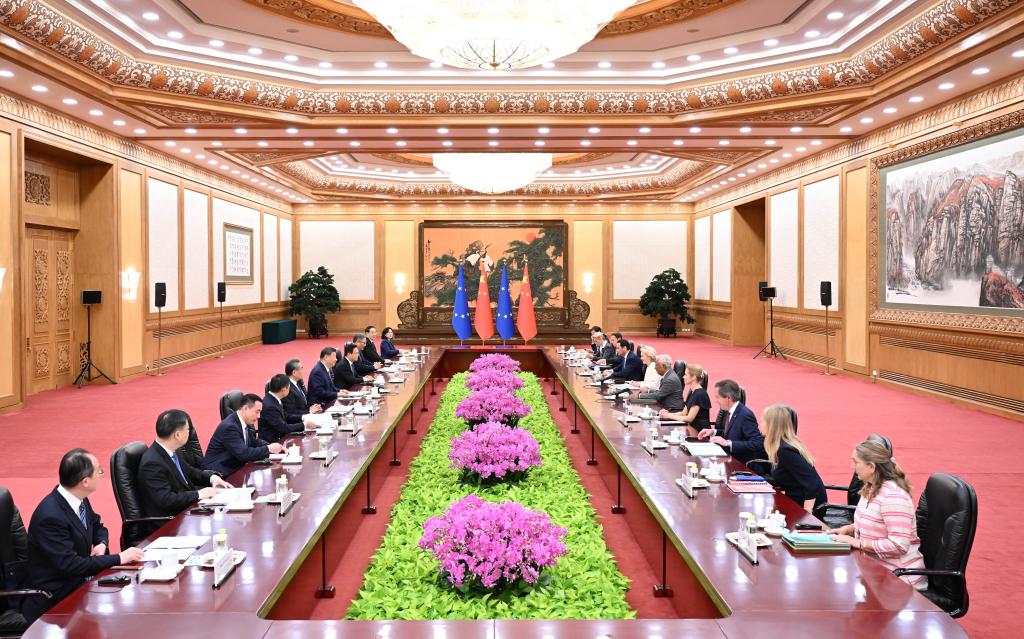
Chinese President Xi Jinping meets with President of the European Council Antonio Costa and President of the European Commission Ursula von der Leyen, who are in China for the 25th China-EU Summit, at the Great Hall of the People in Beijing, capital of China, July 24, 2025. (Xinhua/Li Xiang)